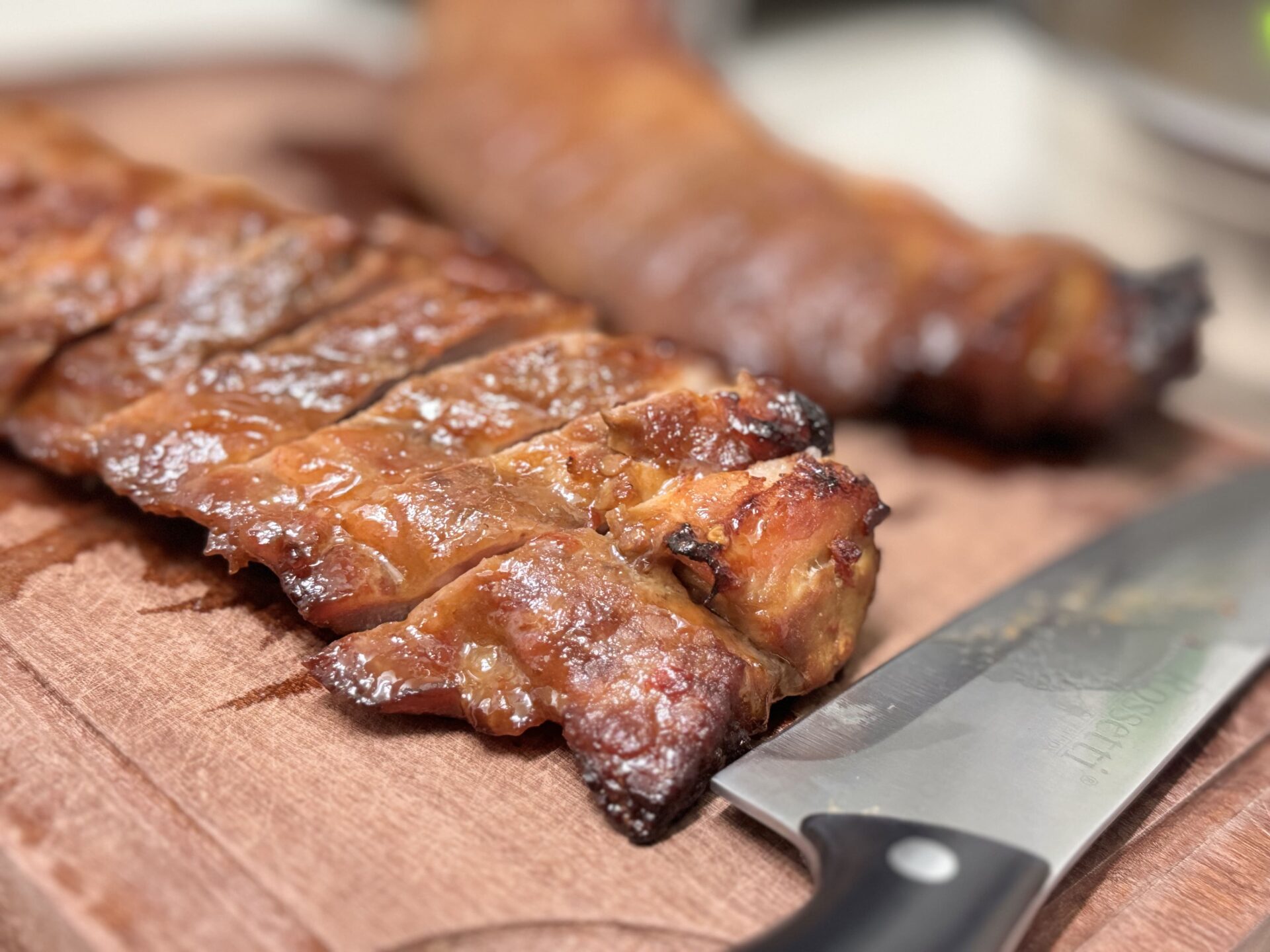
A home cook’s version of the Cantonese classic. Tender, juicy, and covered in a sweet sticky glaze. Great with rice, and meal prep friendly.

Time: 4/5
It’s not as bad as it seems because it’s mostly oven time.
Effort: 4/5
Gotta put in the work if you wanna build up that glaze.
Epiphany
Jump to RecipeI touched on Cantonese barbecue on this blog before when I wrote about my decadent once a year birthday meal – “Siu Yuk” roast pork belly, with shatteringly crispy cracking skin and melt-in-your-mouth fat. That’s not the sort of thing you would eat every day, or even every week. But there are plenty of options in the Cantonese barbecue family that are much more reasonable as a weekend treat.
Char Siu (叉燒) is exactly what it says on the tin. The Chinese characters are literally fork-burn, or more figuratively spit-roast, which is handy because the name is also the instructions. Traditional technique involves hanging well-marinated pieces of pork in massive ovens to roast, then finishing by lacquering them with layer upon layer of sweet sticky glaze that gets ever so slightly charred.
The end result is tender, juicy meat with a flavour profile that sits between savoury and sweet, under a slightly smoky bark. Put that on some rice with a splash of sweet soy sauce, maybe top it with an egg with a runny yolk, and you have a meal so good that they make movies about it.


I always thought that Char Siu is something best left to the professionals, but the success of the roast pork belly gave me the idea to try making Char Siu myself as well. The main concession I made is accepting that I won’t get the bright red colour of commercially made Char Siu, because I don’t want to buy red food dye that I don’t have any other use for (except maybe for Chicken Tikka).
But that was the easy part. Like many recipes with a long culinary tradition, there’s been a lot of time for different manufacturers and producers to create their own variations. There’s no one recipe for Char Siu, there are thousands! (You can even buy pre-made Char Siu sauce off the shelf, but what’s the fun in that?)

Finally, I gave up trying to reverse engineer the perfect recipe. I noticed some common elements across the different methods and filled in with what I have – alcohol from Shaoxing wine instead of the more traditional rose liqueur, sweetness from honey instead of maltose (which is super hard to work with), and the most unorthodox substitution: dobanjang and Japanese miso instead of tianmianjang.
You may look at me like I’m crazy, but I swear it works. Miso and doubanjang give a similar savoury, fermented tang to the marinade, and have the distinct advantage of both being already in my pantry and being useful in a lot of other recipes. The results were close enough to the commercial products, and that’s good enough for a home cook.
And at the end of all the research, all the work figuring out which substitutions to make, and ending up with a satisfactory result, I felt a moment of epiphany. Something akin to a Zen koan appeared in my mind, something that seems to carry importance and relevance beyond the kitchen: at the end of the day, Char Siu is whatever you make of it.
I’ll leave you with that to muse over. In the meantime, onto the Char Siu.

Posts since the last recipe that was actually served with rice: 0
Dramatis Personae
Served 7.
- 2.6lb boneless pork shoulder
Marinade
- 2 tbsp oyster sauce
- 2 tbsp soy sauce
- 2 tbsp sugar
- 1 tbsp doubanjang
- 1 tsp white miso
- 1 tsp shaoxing wine
- 1 tsp white pepper
- 1 tsp Chinese 5 spice
- 1 tsp garlic powder
Glaze
- 200g honey
- Leftover marinade
Also served with about 2kg of choisum. Always eat your veggies!

Executive summary
- Marinade the pork overnight in the fridge.
- Begin cooking by preheating oven to 200C/400F.
- Roast the pork at 200C/400F for about 20 minutes on both sides.
- In the meantime, make rice and vegetables. Loosen up some honey with a bit of the leftover marinade to make the glaze.
- Once the pork is cooked through and juices run clear, brush on a layer of glaze and return to the oven for about 5 minutes. Repeat several times on each side.
- When pork is well glazed and slightly charred, remove from oven and allow to rest. Cut into bite sized pieces and serve.
Play by Play

Last things first. The pork is going to take some time to marinade, so I begin with that.


There isn’t much to it, just mix everything together and massage it into the pork. The doubanjang worked better than I expected – it already comes with a garlicky flavour that compliments the pork well.


Pork goes into the oven, which frees my hands up to do other things.


Like sautéing some shallots, ginger, and scallion whites to form the base of a sweet soy sauce that I’m serving the char siu with. Remember to dilute the soy sauce with at least equal parts water, and make it more sweet than salty.


This is a lot of choisum, and I don’t have the patience to stir fry in batches. So instead I’m blanching them in some water with ginger and a bit of salt. It’s what a lot of hole-in-the-wall diners do too, so I can excuse my laziness with *authenticity*.


Here is where I need you to do as I say, not as I do. I added honey to the marinade instead of the other way around, and as a result the glaze is too thin to properly adhere to the pork – make sure your’s is gloopy, not runny. Brush glaze over pork, and return it to the top rack.

Yours should look a should look better than mine, if your glaze is thick enough. That corner piece with the char is going to be the best part, I can already tell.

A fried egg with a runny yolk is a simple but significant upgrade to any rice bowl. I’m doing one each for this sitting, but not the leftovers – eggs do not microwave well.

Give the pork some time to rest before slicing up. Looking absolutely gorgeous!
Rice, egg, veg, and char siu. Top it off with some of that special soy sauce, and we’re golden.

Remember that premium corner piece with the char? Goes straight to the wife – it’s my love language.

Homemade Cantonese Char Siu Roast Pork
Ingredients
- 2.6 lb pork butt
Marinade
- 2 tbsp oyster sauce
- 2 tbsp soy sauce
- 2 tbsp sugar
- 1 tbsp doubanjang
- 1 tsp white miso
- 1 tsp shaoxing wine
- 1 tsp white pepper
- 1 tsp Chinese 5 spice
- 1 tsp garlic powder
Glaze
- 200 g honey
- Leftover marinade
Instructions
- Marinade the pork overnight in the fridge.
- Begin cooking by preheating oven to 200C/400F.
- Roast the pork at 200C/400F for about 20 minutes on both sides.
- In the meantime, make rice and vegetables. Loosen up some honey with a bit of the leftover marinade to make the glaze.
- Once the pork is cooked through and juices run clear, brush on a layer of glaze and return to the oven for about 5 minutes. Repeat several times on each side.
- When pork is well glazed and slightly charred, remove from oven and allow to rest. Cut into bite sized pieces and serve.


Keep browsing by categories, or by tags:
Beef Blog Broccoli Cabbage Carrots Cast iron Cheese Chicken Curry Dashi Date Night Dried scallops Dried shrimp Eggs Fish and seafood Garlic Ginger Glass noodles Gochujang Honey Miso Napa cabbage Onion Oven Pasta Pork Potatoes Salmon Sesame oil Shiitake mushrooms Shrimp Soup Sous Vide Steaming Stewing Stir fry String beans Sweet potatoes Teriyaki Tofu Tomatoes Vacuum cooker Vegetarian Yogurt Zucchini